The Armory Show NYC 2026 Pt. 1: Three Artists Who Stopped Me in My Tracks

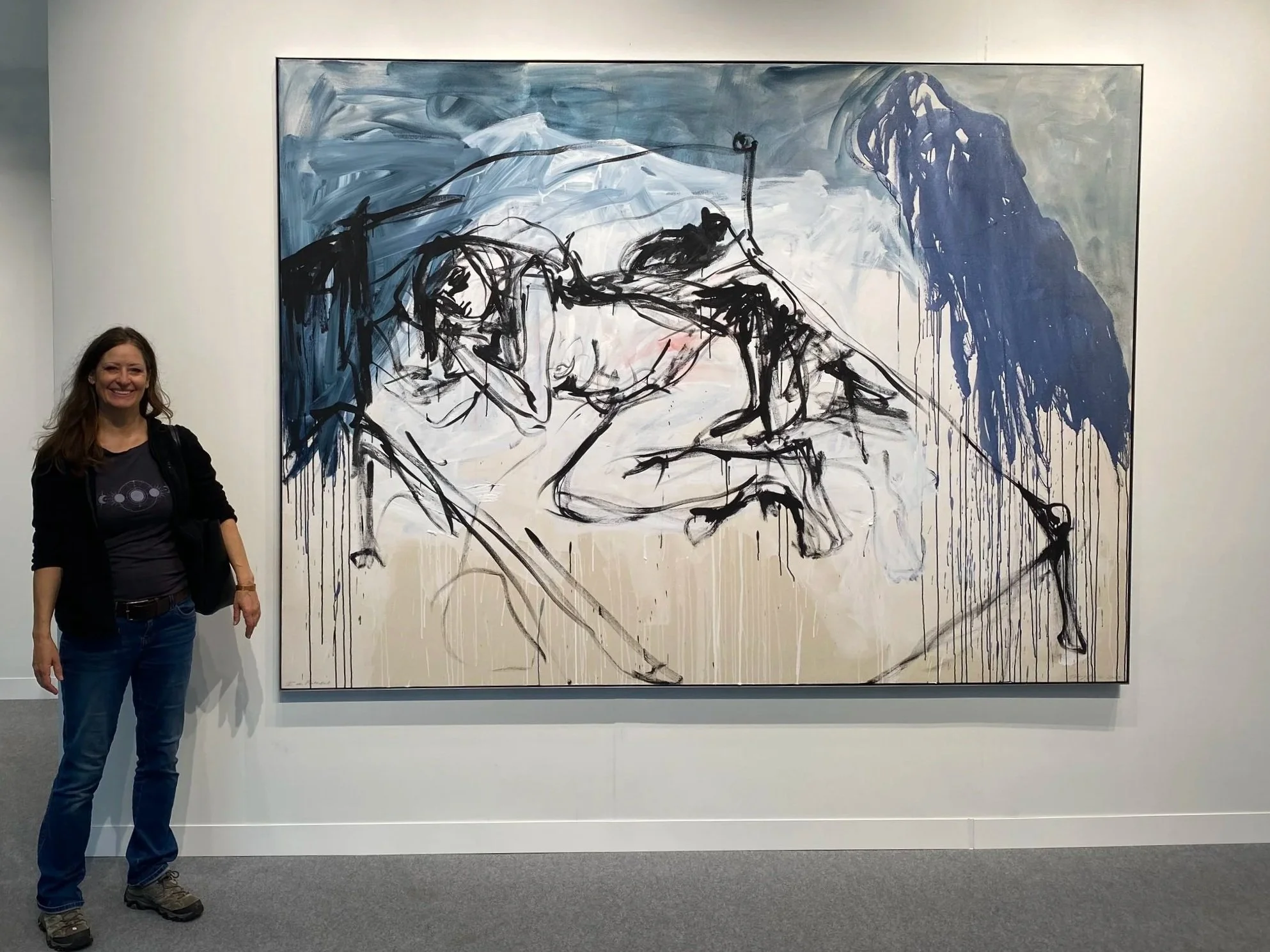
Deb with Tracey Emin painting. Tracey Emin presented by Galleria Lorcan O’Neill Roma at The Armory Show, New York, 2026.

There is something very different about experiencing art at an art fair.

A few years ago, I attended my first major international art fair, Art Basel Paris. I had no idea what to expect or even really how these enormous fairs worked. This time, walking into The Armory Show in New York, I felt much more comfortable.

I bought myself a one-day pass, gave myself about five hours, and decided to move through the show mindfully and gently—stopping when something genuinely caught my attention rather than trying to see everything.

The Armory Show is an annual New York art fair devoted to modern and contemporary art, bringing together galleries and artists from around the world. The 2026 edition ran September 24–27 at the Jacob K. Javits Convention Center in Manhattan. The fair itself dates to 1994, when it was founded at the Gramercy Park Hotel. Its name pays homage to New York's legendary 1913 International Exhibition of Modern Art, commonly known as the Armory Show, which introduced many American audiences to European modernism.

And then there is the Javits Center itself. The glass-and-steel building, originally designed by I. M. Pei & Partners, feels like an artwork in its own right. After spending hours inside the fair, I found a Starbucks, sat in the enormous glass atrium, put my feet up and began writing these notes while everything I'd just seen was still fresh in my mind.

What struck me most that day wasn't simply what I liked, but what those choices seemed to tell me about myself as an artist.

Again and again, I found myself pulled toward minimalism, abstraction and simplicity—but also toward artists doing something technically unexpected. I wanted to know: How did they make that? Why did they choose that material? How did they arrive there?

I think what we're drawn to informs us. It inspires us and teaches us, but it can also tell us something about what matters to us creatively.

With that in mind, these are three of the artists who stopped me in my tracks.

Tracey Emin
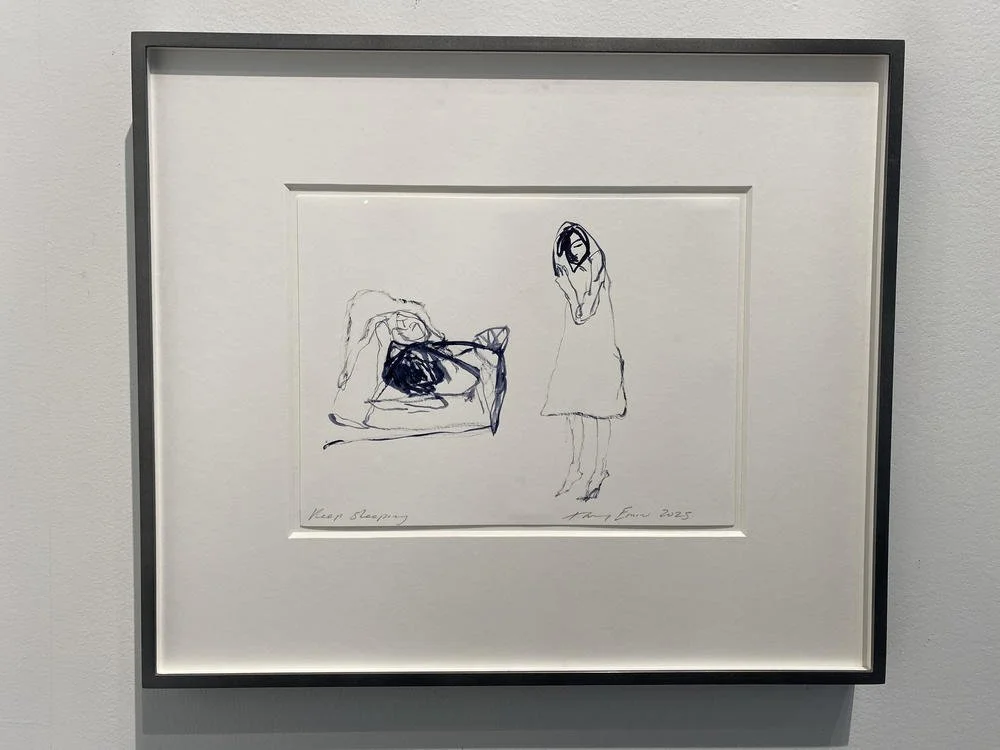
Of all the original works I encountered at The Armory Show, seeing Tracey Emin's paintings in person was probably the most exciting for me.

I'd watched a beautiful Sotheby's interview with Emin several years ago and was struck by her vulnerability, authenticity and the extraordinary trajectory of her career. Her work has always felt intensely personal to me—the kind of work in which the artist doesn't seem to be hiding behind the art.

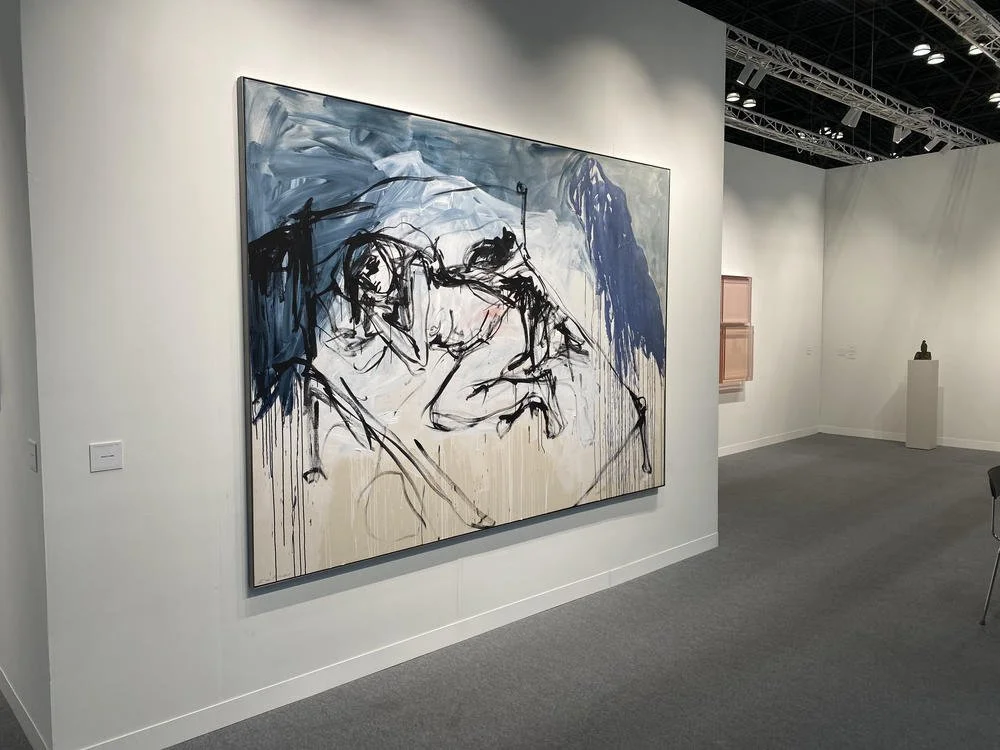
Born in 1963, Emin is a British artist whose practice encompasses painting, drawing, sculpture and numerous other media. Her work was presented by Galleria Lorcan O'Neill Roma at The Armory Show. The works weren’t individually titled on the gallery label, so I’ve left those details out.

Seeing the large-scale figure painting in person was as captivating as I'd hoped it would be.

There is such freedom in Emin's figures. I love the abstraction within them, the looseness of the marks and her restrained use of colour. There is something about seeing that freedom at this scale that simply can't be replicated on a screen.

And perhaps that's part of what I respond to so strongly in her work: it feels vulnerable without feeling tentative.

I also admire Emin for something that goes beyond her own studio practice. Through the Tracey Emin Foundation, she has established TKE Studios and the Tracey Emin Artist Residency in Margate, creating opportunities and space for other artists to develop their work. For me, using the success of an extraordinary career to help support other creators is deeply meaningful.

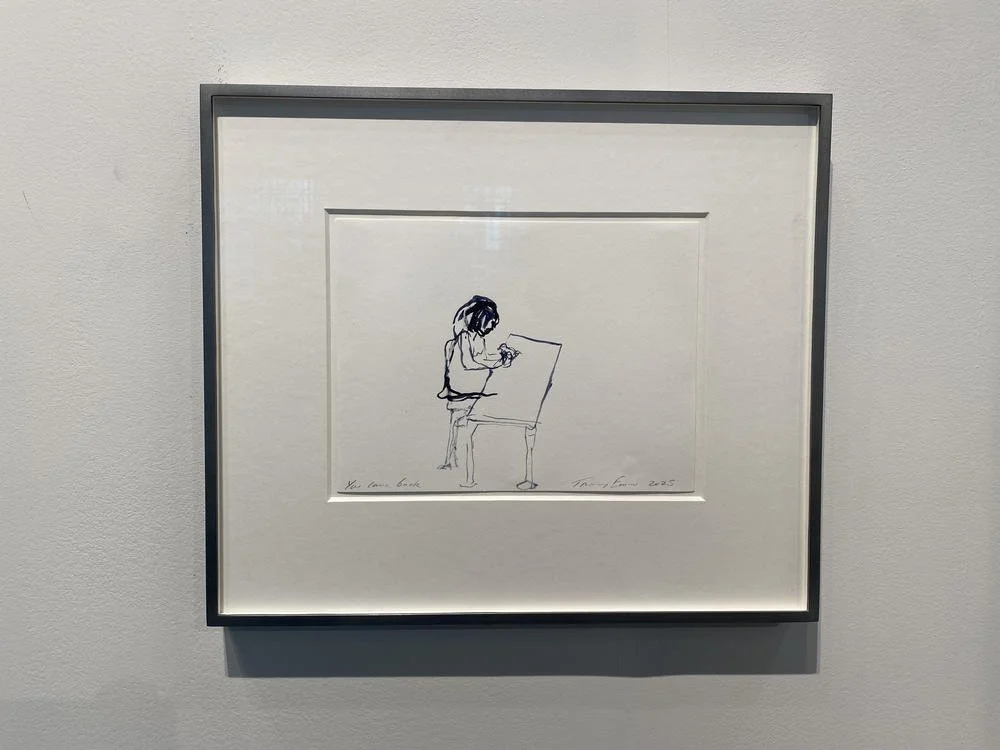
It was a real treat to stand in front of this enormous painting—and then to move closer and spend time with the smaller works nearby.

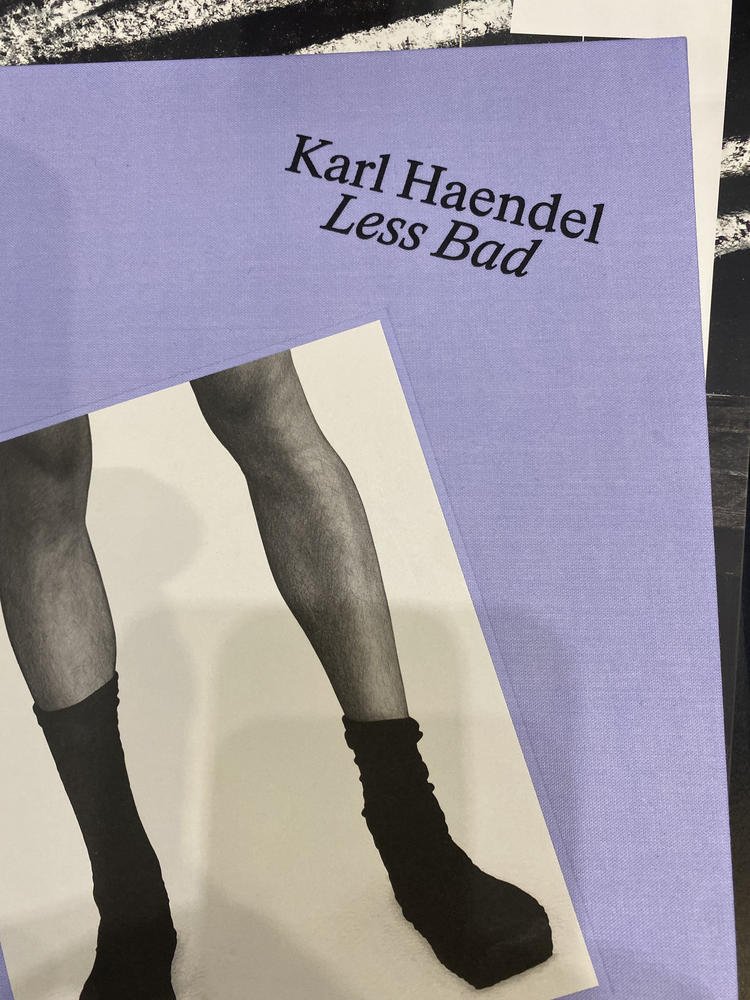
Karl Haendel
Sometimes an artwork pulls me in before I know anything about the artist.

That happened with Karl Haendel.

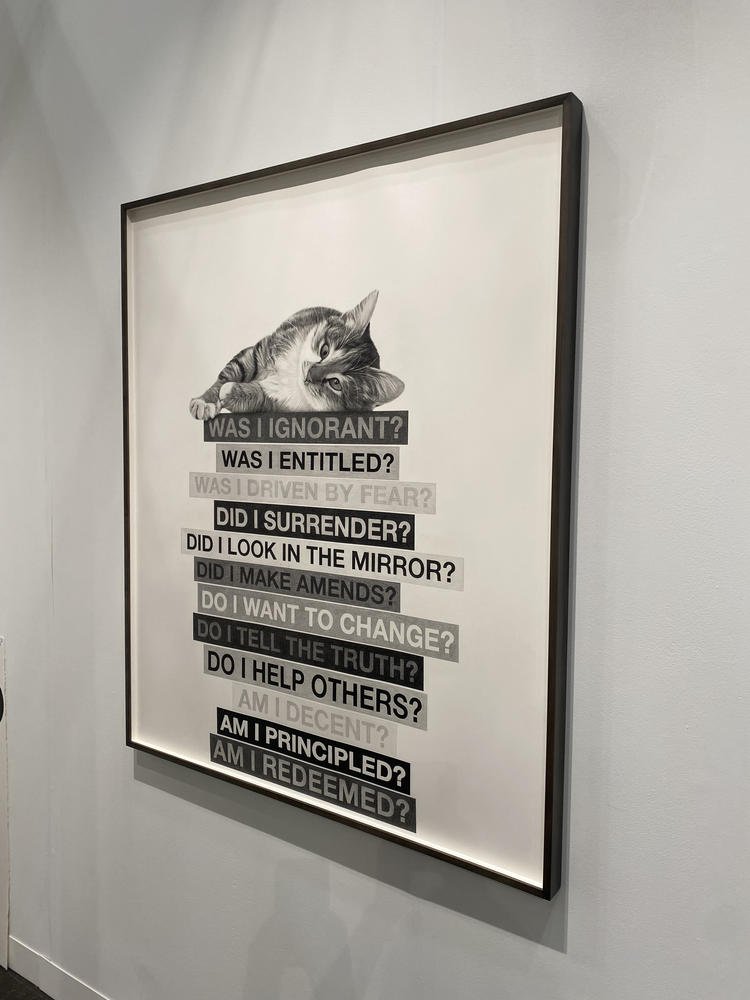
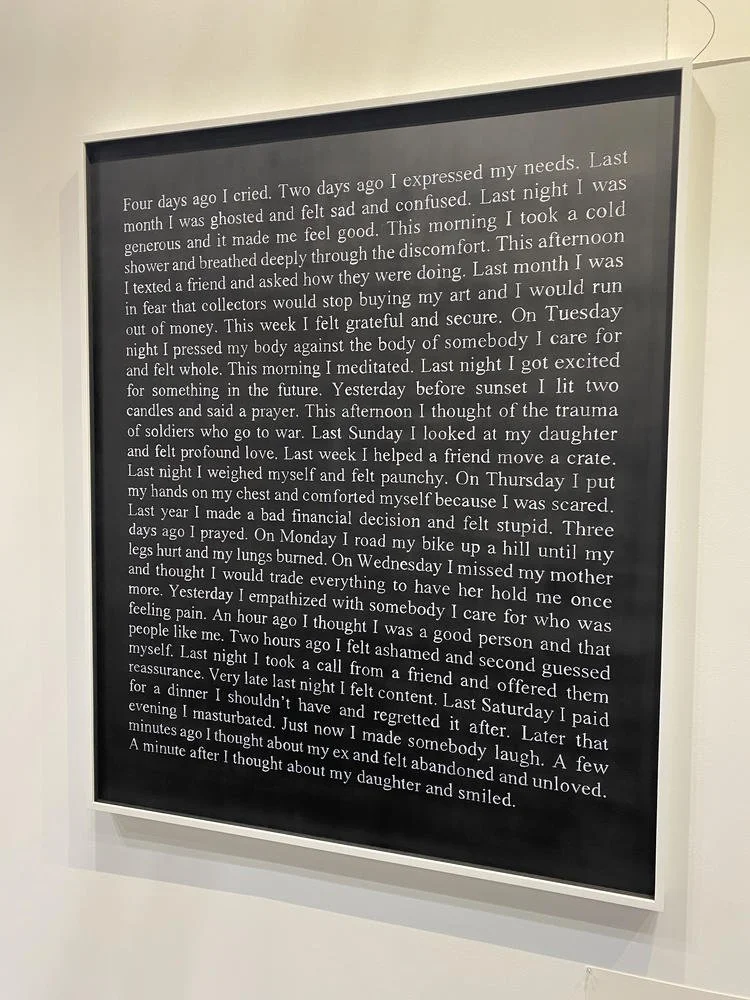
From a distance, what caught me was the simplicity: a large-scale black-and-white work composed largely of text. But once I began reading it, I stayed.

The work was Four Days Ago I Cried, created in 2026 by Haendel, a New York-born artist who lives and works in Los Angeles. He was presented at The Armory Show by Vielmetter Los Angeles. The work is made with wax pencil on enamel on paper and measures 54¼ × 44⅞ inches including its frame.

The writing was what really pulled me in.

It moved through what felt to me like the contradictions of being human: feeling good and then feeling bad; being in your zone and then out of it; confidence followed by doubt; connection followed by disconnection.

I just stood there and read.

I've always loved words and text incorporated into art. When they're used well, words become something visual as much as literary, and this piece felt beautifully pared down. The black and white, the simplicity of its presentation and the candidness of the language allowed the words themselves to hold the space.

After reading it, I moved farther into the gallery presentation to see more of Haendel's work.

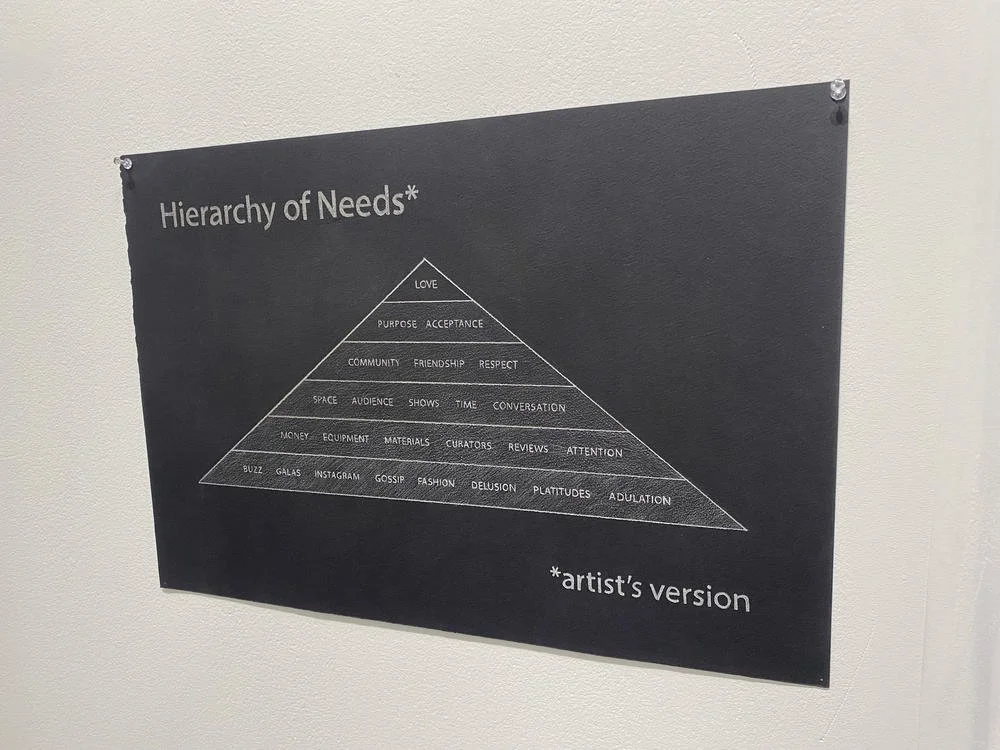
Another work, headed Hierarchy of Needs, particularly caught my attention from the perspective of being an artist. Other pieces continued that sense of directness and simplicity that had initially drawn me into his work.

There was something very relatable about the entire group.

Simple. Candid. Deep.

And beautifully executed.

Alexandria Tarver
And then there was red.

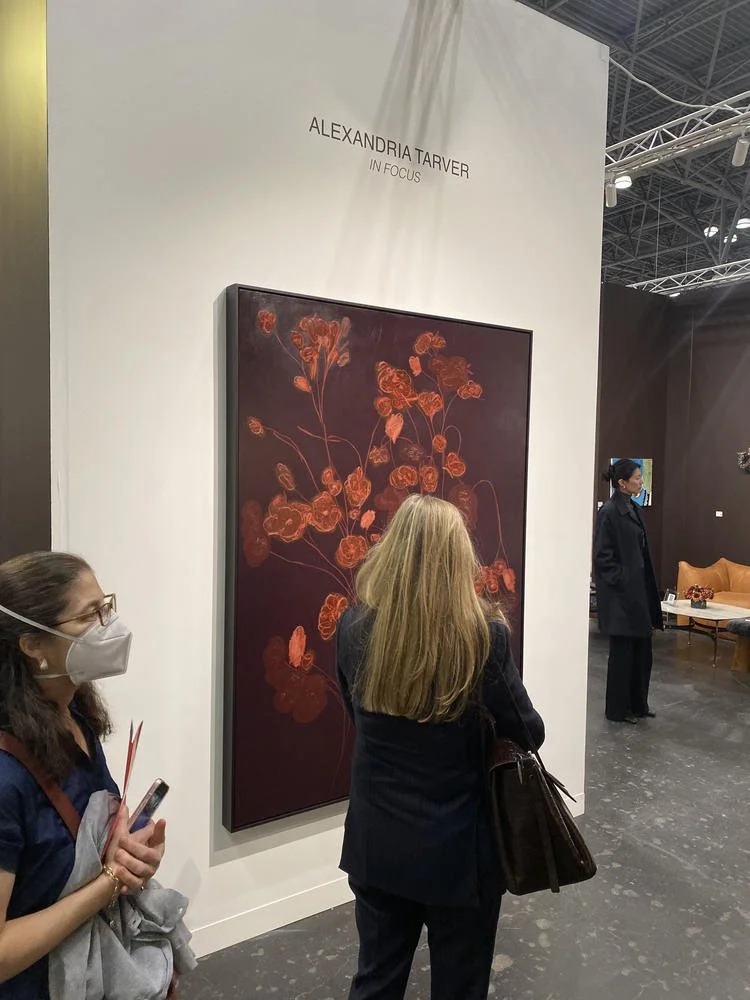
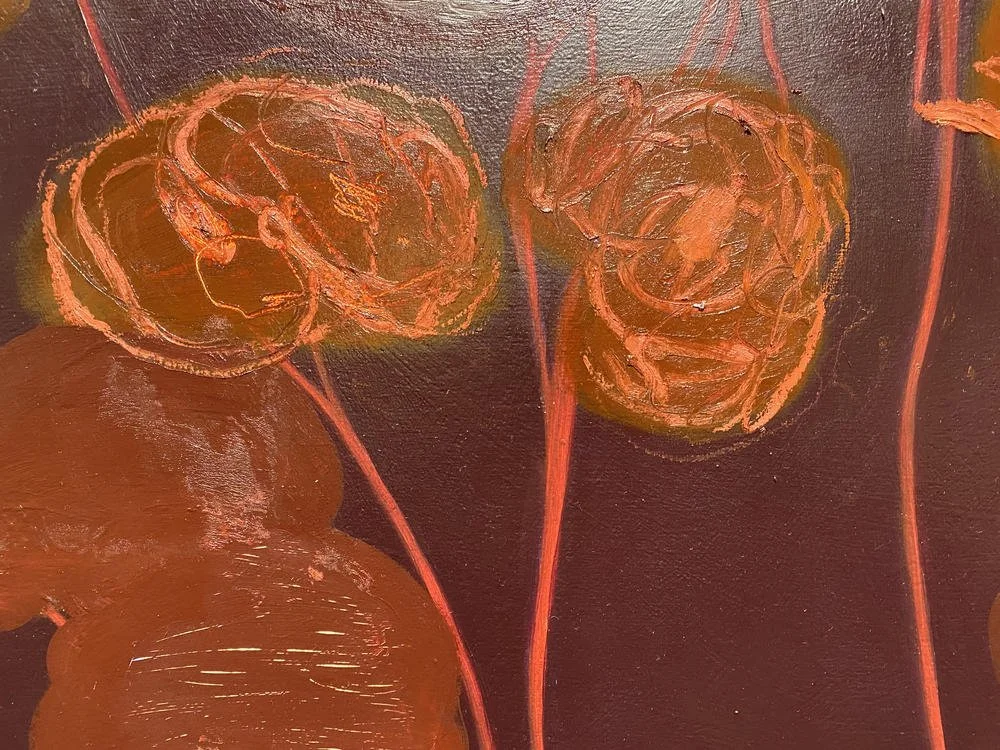
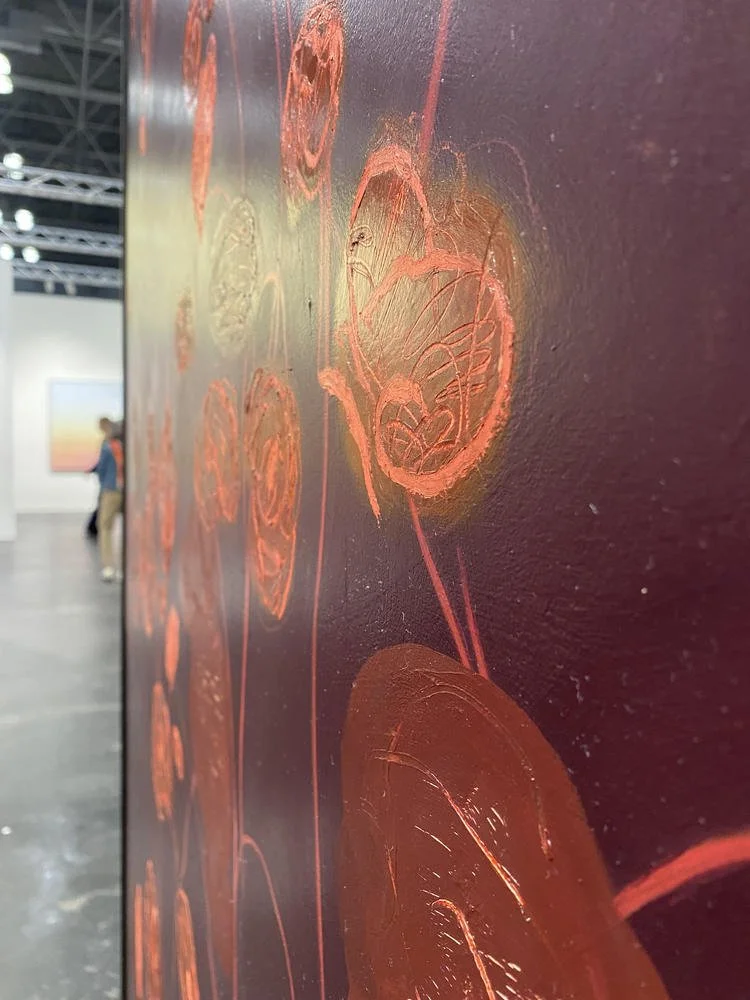
I spotted Alexandria Tarver's enormous floral painting and it immediately grabbed my attention.

The painting is overwhelmingly red—red against red, with shifts in tone and perhaps orange moving through it. For me, that makes the palette particularly challenging. Creating enough variation, depth and visual interest within such a narrow colour range is not an easy thing to do.

And Tarver made it work beautifully.

What I especially appreciated—when I moved in for a closer look—was the texture. It's present without overwhelming the painting. From farther away you experience the flowers and colour; closer in, you begin to experience the surface itself.

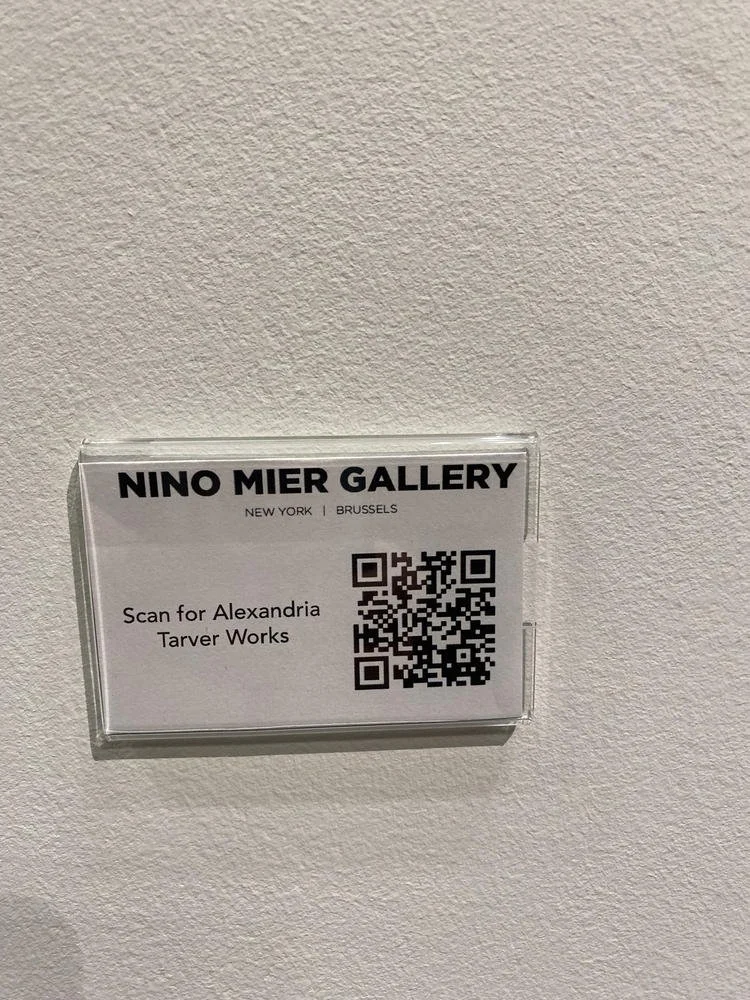
Tarver's flower paintings also have a personal history. A gallery account traces the beginning of this body of work to 2013, when her father received a terminal cancer diagnosis. Her work at The Armory Show was presented by Nino Mier Gallery.

This is also the kind of painting I probably would never make myself. I generally don't paint subjects like flowers.

But would I hang it in my home?

Absolutely.

I could imagine this in a hallway where you'd encounter that extraordinary field of red every time you walked past. I thought it was beautiful and masterfully executed.

And perhaps that's another reason I love looking at other artists' work: admiration doesn't require wanting to make the work yourself.

Sometimes you simply want to live with it.

What I Took Away From The Armory Show
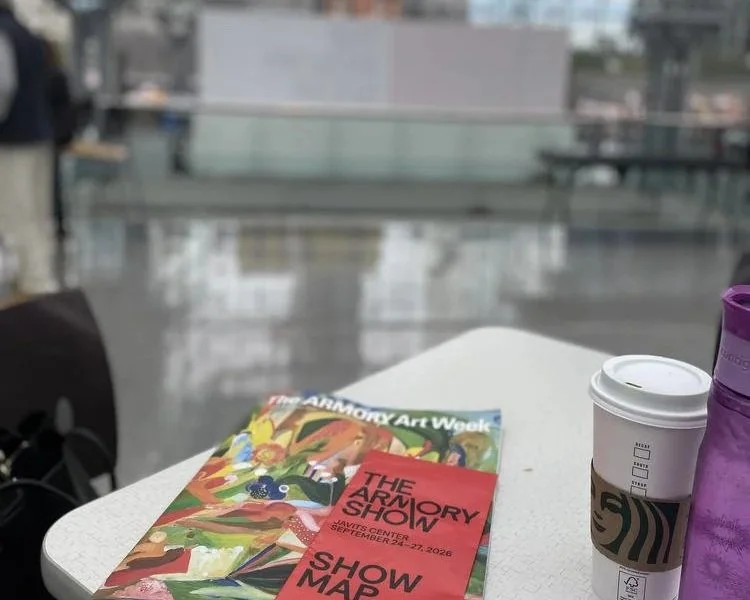
Sitting in the Javits Center atrium afterward and thinking about what I'd seen, I kept returning to the same observation.

I was drawn to simplicity.

But not necessarily simple ideas.

I loved the freedom and vulnerability I found in Tracey Emin's figures. I loved how Karl Haendel reduced an intensely human experience to words and black and white. And I loved how Alexandria Tarver took what could be a traditional subject—flowers—and made colour itself part of what stopped me.

I also noticed how much I'm attracted to artists who make me curious. Work that makes me want to get closer. Work that makes me wonder about process. Work that shows me something I haven't considered doing myself.

As an artist, I think there is tremendous value in paying attention to that instinct.

What stops you?

What makes you cross the aisle for another look?

What makes you lean closer?

Because sometimes what we're drawn to in somebody else's work quietly tells us something about where we might want to go in our own.

And there were three more artists at The Armory Show who made me do exactly that—this time through extraordinary materials and processes.

I'll share those in Part Two.
A Movie Night with My Dad at VIFF: The Art of Adventure

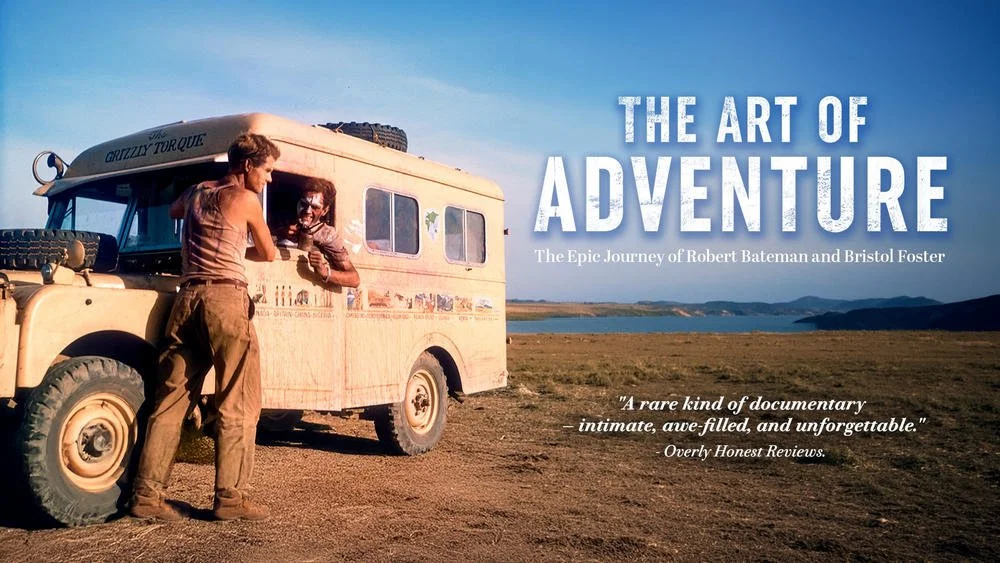
There’s something really special about going to a film festival screening—especially at the VIFF Centre in downtown Vancouver. My dad and I recently went to see The Art of Adventure, and even before the film began, the experience itself felt inspiring. The theater was intimate and cozy, filled with people who genuinely love film, storytelling, art, and culture. It felt personal in the best way.

The 90-minute documentary follows the lifelong friendship of celebrated Canadian wildlife artist Robert Bateman and biologist Bristol Foster, beginning with an extraordinary trip they took together in their twenties. In 1957–58, they traveled more than 14,000 kilometres across Africa, India, Southeast Asia, and Australia in a rugged Land Rover nicknamed “The Grizzly Torque”.

What struck me most about the film wasn’t just the adventure itself—though the vintage footage and stories were incredible—it was the humanity behind it all.

Like many Canadians, I already knew Robert Bateman as a highly respected wildlife painter. But truthfully, I didn’t know much about him personally. Seeing the archival footage of him as a young man traveling the world with his best friend made him suddenly feel deeply relatable and human. Their friendship was tender, funny, adventurous, and grounded in a genuine love of nature and curiosity about the world.

There was one moment in the documentary that especially stayed with me. During interviews, Bateman’s children mentioned that his work is not included in the National Gallery of Canada collection. Honestly, I found that shocking. Considering not only the artistic legacy he’s created, but also the enormous impact he and Bristol Foster have had on environmental awareness and conservation in Canada, it feels like a profound oversight.

The film beautifully highlighted how much both men contributed to protecting ecological areas, educating the public, and inspiring reverence for the natural world. Those themes deeply resonate with me personally. As someone who feels continually nourished and inspired by nature—and who creates artwork rooted in connection, grounding, and well-being—I found myself unexpectedly moved throughout the film.

What shifted for me afterward was a much deeper respect for Robert Bateman, not just as an artist, but as a human being. And honestly, sharing the experience with my dad made the evening even more meaningful.

If you love art, nature, travel, environmental storytelling, or films that leave you feeling more connected to life itself, I'd absolutely recommend checking out The Art of Adventure. You can watch the official trailer on YouTube or read this thoughtful review in the Vancouver Sun for a deeper dive into their story.

Visiting Fishhead Studio on Gabriola Island

Recently I had the privilege and joy of visiting Fishhead Studio here on Gabriola Island with our current artist in residence, Cassandra Myers.

Fishhead Studio is the creative world of Dave and Tammie Hennigar—two incredibly welcoming artists whose work spans sculpture, lighting, folk art, painting, reclaimed objects, driftwood, concrete, mixed media, and beautifully inventive found-material creations. Their studio is filled with imagination, humour, texture, craftsmanship, and a true spirit of experimentation.

From the moment we arrived, it felt less like entering a gallery and more like stepping into an extension of their creative lives.

What I especially loved was hearing stories about their years living and homesteading in the Yukon. There was something deeply grounding and inspiring about listening to artists who have built such an expansive creative practice through curiosity, resourcefulness, and hands-on exploration.

We had wonderful conversations about sculpture, materials, making art, and the process of simply figuring things out as you go.

One of my favourite parts of being an artist is that moment of not fully knowing how something will come together—and realizing that discovery itself is part of the art form. Dave and Tammie embody that beautifully. Their work carries a sense of play, experimentation, and trust in the creative process.

I also loved seeing how reclaimed materials and found objects become transformed in their hands. Old wood, metal, fishing gear, driftwood, and salvaged objects become whimsical sculptures and thoughtful works filled with story and character.

These are such beautiful people, and I’m truly grateful for the opportunity to visit, connect, and spend time in their creative space.

Thank you Dave and Tammie for your generosity, conversation, and inspiration. If you’re visiting Gabriola Island, Fishhead Studio is absolutely worth experiencing!

Fishhead Studio
2515 Coho Drive
Gabriola, BC Canada V0R 1X7
250-327-1503
fishheadstudio.ca@gmail.com
Follow their work on Instagram and Facebook.

A Hidden Gem in Dunbar: Discovering Mónica Reyes Gallery

Exterior of Mónica Reyes Gallery in Vancouver's Dunbar neighbourhood, with black wrought iron bistro furniture and planters out front.

While visiting Vancouver in May, I had one of those wonderful little unexpected moments that remind me why I love wandering and staying open to surprise.

I was driving back from an outing when, out of the corner of my eye, I spotted a gallery I had somehow never noticed before. Tucked quietly into the Dunbar neighbourhood, it almost felt hidden away—understated, elegant, and quietly calling me in.

So naturally… I pulled the car over immediately.

As luck would have it, the gallery was just closing. But gallerist Mónica Reyes graciously stayed open for a few extra moments and warmly invited me in to enjoy the current exhibition. Those small acts of generosity and openness always stay with me.

The Exhibition

Stepping into the gallery, I took in the exhibit of Vancouver artist Julia Soderholm, whose work I found incredibly refreshing.

The paintings feel deeply rooted in observation of the natural world while remaining abstract and intuitive. Colour, gesture, movement, atmosphere, and memory all seem to coexist within the work. I especially loved the way certain pieces evoked landscape without ever becoming literal—moments of sky, water, trees, light, and distance all hinted at through layered marks and luminous colour relationships.

There’s a looseness and confidence in Julia’s paintings that I really appreciated. The work feels alive. Spacious. Unforced.

A few paintings in particular pulled me in—especially the larger works with saturated blues, greens, violets, and soft chartreuse passages that seemed to vibrate against one another. The paintings carried that beautiful balance between structure and intuition that I’m always so drawn to in abstract painting.

I also loved the scale and simplicity of the gallery itself. Clean white walls, beautiful natural light, and enough breathing room for the paintings to really speak.

If you’re in Vancouver and love contemporary abstract art, I highly recommend stopping in.

Exhibition Details

The day comes with a colour
Paintings by Julia Soderholm
May 14 – June 27, 2026

About the Artist Currently on Exhibit

Julia Soderholm is a Vancouver-based painter currently completing her MFA at Emily Carr University. Her work explores abstraction and landscape through layered paint, gesture, memory, and colour. The paintings invite viewers into a kind of re-enchantment with the natural world — something I could absolutely feel while standing in the gallery.

Gallery Information

Mónica Reyes Gallery
2895 West 33rd Avenue
Vancouver, BC V6N 2G3
604-339-2096
Instagram: @monicareyesgallery

Gallery Hours
Wed–Sat 11 AM–3 PM

Celebrating Creativity: Gabriola Island Studio Tour 2025

Deb & Deb together at Deb Dallyn’s open studio, October 2025

I had the joy of visiting many wonderful studios open during this year’s Gabriola Island Studio Tour 2025.

Every Thanksgiving weekend, our island comes alive with color, creativity, and connection as over 60 artists open their doors, sharing their processes and stories with visitors from near and far.

This year, one of my favourite artists to visit was assemblage artist Deborah Dallyn, whose work defies easy categorization.

Her art is at once playful, profound, and deeply human—each piece revealing the poetry in found materials thoughtfully transformed into sculpture. There’s something whimsical yet timeless in her creative voice that truly resonates with me.

Deb Dallyn standing beside my favourite Piece of hers.

My favourite artwork on display this year was a framed white circular piece combining paint, rocks, and wood—absolutely gorgeous. (See above photo.)

I also loved her moving flag installation—a kinetic larger scale work full of movement and spirit—and her tall, colorful wooden sculpture inscribed “A True Radical Makes Hope Possible” (see below), standing proudly over five feet tall. Fantastic!

Beyond her studio, Deborah is also the creator of the acclaimed public art installation Rite of Passage, located here on Gabriola Island. You can learn more about that project and her community contribution here.

If you’re interested in learning more about Deborah’s work or inquiring about collecting her art, I highly encourage you to connect with her directly through the Gabriola Arts Council Artist Directory.