Canada Council for the Arts Grant Supports Deb Chaney’s Professional Development

Deb Chaney is proud to share the receipt of a Canada Council for the Arts grant supporting professional development and continued growth as a working artist. This recognition represents an important milestone and provides valuable support for expanding knowledge of the global professional art landscape.

As a contemporary Canadian artist working in mixed media abstract painting, Chaney continues to invest in deepening both the creative and professional aspects of her practice. This funding supports participation in a specialized professional development program designed to help artists better understand and navigate the international art world.

The training focuses on key areas such as gallery relationships, professional positioning, and the structure of the global art market—knowledge that helps artists build sustainable careers and expand opportunities for their work.

Continued professional development ensures that collectors, curators, and institutions encounter work that reflects both artistic depth and a strong understanding of the evolving professional art ecosystem.
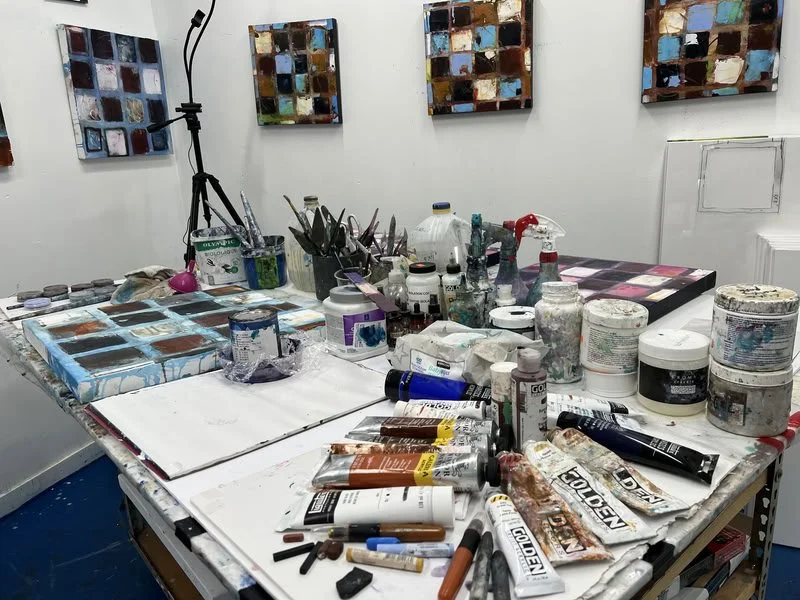
Inside Deb Chaney’s studio during the development of recent mixed-media abstract paintings.

About The Canada Council for the Arts

The Canada Council for the Arts plays a vital role in our cultural landscape. It has been a driving force in the arts, consistently demonstrating the social and economic importance of sustained investment in the arts.

The Canada Council for the Arts mandate is to foster and promote the study and enjoyment of, and the production of works in, the arts. Through its grants, services, prizes, initiatives, and payments, the Canada Council supports a dynamic and diverse arts and literary scene. These activities generate a meaningful cultural, social and economic impact for over 2,000 communities in all parts of the country and beyond. The investments and leadership of the Council help advance public engagement in the arts from coast to coast to coast while also contributing to the international recognition of artists and arts organizations from Canada.

With French-speaking audiences across the country in English-speaking regions, the Canada Council for the Arts offers support in both official languages.


Special thanks to Diana Cave, Grant Officer at the Canada Council for the Arts, whose guidance and encouragement throughout the process were incredibly helpful. Her support made navigating the application process clear, supportive, and accessible.


Support from the Canada Council for the Arts strengthens the foundation for continued artistic growth and the creation of new work for collectors, galleries, and institutions in the years ahead.

Black & white logo for Canada Council for the Arts
 

We acknowledge the support of the Canada Council for the Arts.

You can find out more about Canada Council for the Arts on X (Twitter) at @CanadaCouncil and under the #BringingTheArtsToLife hashtag.

Interview from Macedonian Art Student

Recently, via Facebook Sasho Ackovski from Macedonia contacted me and asked me a few question about being a professional artist. First, here is a little about Sacho and what he is doing with respect to his art and studies ...

"Hi Deb...firstly I want to thank you for your answers, it will be a great help for may essay. I will use this answers for my exam in history of art, I should write a short essay about " what conditions must to be done if you want t o be a free artist (professional artist)" I intend to make comparison of conditions in my country- Macedonia with conditions from other countries if I get response from other artists. This essay is a part of larger project which we need to do with my colleagues, we should explore the relations between artist, audience and institutions. My task is "Free artist"...a kind of institutional critique.
The essay will not be published in media , it will be used only for a personal purpose and if you allow me your name will be mentioned in the essay. If you are interested in I will send you a finished version.
I found you accidentally on net, when I looking for an idea to make some painting and I saw some of your paintings….and than I sand you a friend request……
I live in Skopje the capital city of Macedonia,I am born in 15.07. 1972. I have finished high school of economy. Now I am a student faculty of fine arts in Skopje “St. Ciryl and Metodius”. This is my final year of study, I will graduate in June as a “Painter with directions- conservations and restoration”. I have several group exhibitions and I hope that my solo exhibition will happen next summer. Except studying I am working a part time as a waiter in a hotel “Aleksandar palace” to pay for my study. My hobby is playing a guitar."

I thought I would share this with you as some of you may be interested in his questions and my answers.

1. How many solo exhibition you need to get status as a professional artist ?There is no set number of exhibition you have to have that I know of. But if you are applying for a certain competition or status (ex. I am an elected member of the Society of Canadian Artists which gives me SCA status) they might sometime ask that you have done 'X' number of show before you can submit to them.

2. Is it necessary some kind of art education ? Many artists that I work with and have mentored with have no formal art education. Many of my contemporaries also have plenty of art education -- BA, MFA, pHD. It varies. Education does not = success.

3. Do professional artists have any support by institution,state, museums and galleries?It's going to be different in every country. For example, in Canada you can apply for grants through the Canada ARts Council ( government funded). When I lived in California USA, there were many private grants available. There are programs and funding available through museums and so on but I don't have much knowledge of them.

4. Does he pay taxes ? Yes, when you are earning money as an artist it is like any other business, you must declare your income and pay taxes.

5. Some information about paying health and pension insurance and pension. Basically you are considered a sole proprietor/self employed so you have to look after all of these things for yourself.

6. Is it possible financially to survive as a free artist or you need extra job ? Most artist have another job, but, it is possible - I work solely as an artist and support myself from the sales of my fine art and my workshops. I don't have another job. :)

7. Which term you use for- free artist ? Professional artist. for me, that means someone who is making money from their art. As opposed to a hobbiest.

8. Few things that you do not like about work of institution, museums and galleries? Basically as soon as you start working with them ( museums, galleries, etc) you have to enter into an agreement in which you must abide by their rules. Some galleries won't let you be shown at other galleries. Some galleries may take a % of sales income if you sell an art piece directly to a collector. Some galleries force you to charge the same prices as their gallery at your open studio show and other shows. The list goes on.... Each artist has to decide if the agreement is worth it for them.

9. By the way I like your style of painting... Thank you